

AI and Jobs: What Business Owners Really Need to Know
By AZ Konnect Team
12/3/20253 min read
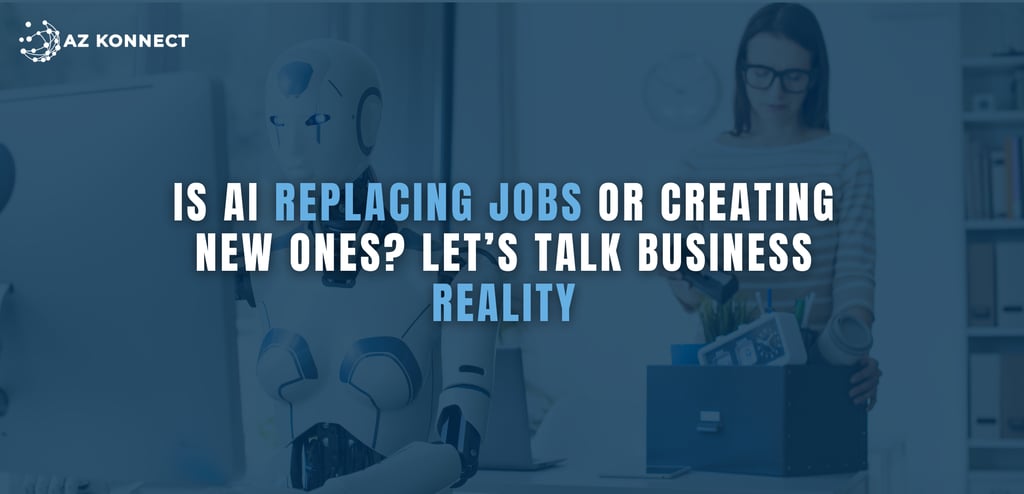
Is AI the Job Killer or the Job Creator?
It’s one of the hottest debates in the business world right now:
“Is AI going to replace my team?”
We’ve seen the headlines.
We’ve heard the fear.
But here’s the truth: AI is changing jobs not just replacing them.
Yes, some roles are disappearing. But many more are evolving, and entirely new roles are being created ones that didn’t even exist five years ago.
In this blog, we’ll break down:
What kinds of jobs AI is actually replacing
What roles are being created or transformed
How you, as a business owner, can adapt your workforce and lead the change
Let’s cut through the noise and get to the facts.
AI Is Replacing Jobs But Not the Way You Think
Let’s not sugarcoat it: AI is automating some tasks out of existence. But it’s not coming for everyone’s job it’s coming for specific functions inside roles.
Jobs Most Affected by AI Right Now:
Data entry & admin: Spreadsheets, reports, form submissions
Basic customer support: FAQs, tracking, password resets
Simple copywriting: Product descriptions, ad headlines
Routine scheduling & booking
Manual inventory updates
These aren’t entire careers they’re low-value, repetitive tasks.
And when those tasks are handled by AI?
Humans are free to focus on strategy, creativity, and relationship-building.
Jobs Are Being Re-Invented, Not Erased
Here’s what’s actually happening in the workplace:
Old Role:
Customer Support Agent
→ Spent hours answering repetitive tickets manually.
New Role:
AI Support Specialist
→ Oversees chatbot flows, steps in for complex issues, improves customer satisfaction.
Old Role:
Marketing Assistant
→ Wrote newsletters, scheduled posts, tracked analytics manually
New Role:
AI Marketing Operator
→ Manages automation tools, tests AI-generated content, runs smart A/B campaigns.
Old Role:
Data Analyst (Manual)
→ Pulled reports, created dashboards, and interpreted trends from raw data.
New Role:
AI Business Intelligence Lead
→ Builds predictive models, uses AI to drive smarter decisions faster.
AI Is Also Creating Entirely New Jobs
Here’s the part that doesn’t make the headlines: AI is fueling job creation.
New AI-Driven Roles We’re Seeing:
Prompt Engineers (yes, it’s a real job!)
AI Workflow Architects
Chatbot Trainers
AI Compliance Specialists
Synthetic Data Analysts
Human-AI Collaboration Designers
Fun Fact: According to LinkedIn’s Emerging Jobs Report, roles like “AI Specialist” and “Machine Learning Engineer” have grown 74% annually in the last few years.
What the Data Really Says
Let’s look at the numbers behind the noise.
Source Insight
PwC Global AI Study AI could contribute $15.7 trillion to the global economy by 2030.
World Economic Forum AI will displace 85 million jobs but create 97 million new ones.
McKinsey & Co. 60% of jobs have at least 30% automatable tasks not the full job.
So yes, change is coming. But it’s not all doom and gloom it’s opportunity.
What Smart Business Owners Are Doing Right Now
The best business leaders aren’t fighting AI they’re future-proofing their teams.
Here’s how:
1. Upskilling & Reskilling
Instead of laying people off, forward-thinking companies are training their current teams to use AI tools.
Example:
A virtual assistant becomes a chatbot manager.
A copywriter learns to use Jasper to scale content creation.
2. Hiring for Hybrid Roles
They’re not just looking for marketers or developers they’re hiring AI-savvy operators who understand how to collaborate with automation.
3. Creating Human-AI Partnerships
They use AI to handle the routine, so humans can do what humans do best:
Build relationships
Solve unique problems
Think creatively
How to Prepare Your Business for the Shift
Step 1: Identify What Can Be Automated
Audit your operations. Look for tasks, not people, to replace:
Data entry
Simple customer inquiries
Content generation
Basic analytics
Step 2: Upskill Your Team
Start offering micro-courses or paid time for employees to learn:
AI tools (like ChatGPT, Jasper, Zapier)
Prompt writing
Workflow building
Step 3: Redefine Roles, Don’t Remove Them
Reimagine job descriptions around AI collaboration, not displacement.
Step 4: Hire Smart, Not Just Techy
Look for adaptability, curiosity, and systems thinking. You don’t need coders you need AI-literate thinkers.
FAQs: AI & The Future of Work
Q: Will AI replace my employees?
Not if you train them to evolve with it. The goal is to let humans focus on higher-value work not eliminate them.
Q: Are AI jobs only for tech experts?
Not anymore. Many AI roles involve strategy, communication, design, and operations not just coding.
Q: How do I start training my team?
Offer access to tools like ChatGPT, Jasper, or Notion AI. Start with real, everyday use cases.
Q: Is it worth investing in AI now, or should I wait?
Wait too long and you’ll fall behind. The earlier you start, the more prepared you’ll be as the tech matures.
Final Thoughts: AI Isn’t a Threat It’s a Shift
Here’s the bottom line:
AI is transforming the workplace, but not in the apocalyptic way people think.
Yes, tasks are being automated.
Yes, some roles are evolving.
But behind the fear is a huge opportunity for growth, efficiency, and innovation.
Smart businesses aren’t replacing people with AI.
They’re building hybrid teams where humans + AI = superpowers.
So instead of asking,
“Will AI take jobs?”
Start asking:
“How can I create better ones with it?”
Resources to Dive Deeper:
Future of Jobs Report – World Economic Forum
McKinsey’s Guide to the AI-Powered Organization
PwC AI Global Study
Subscribe To Our Newsletter