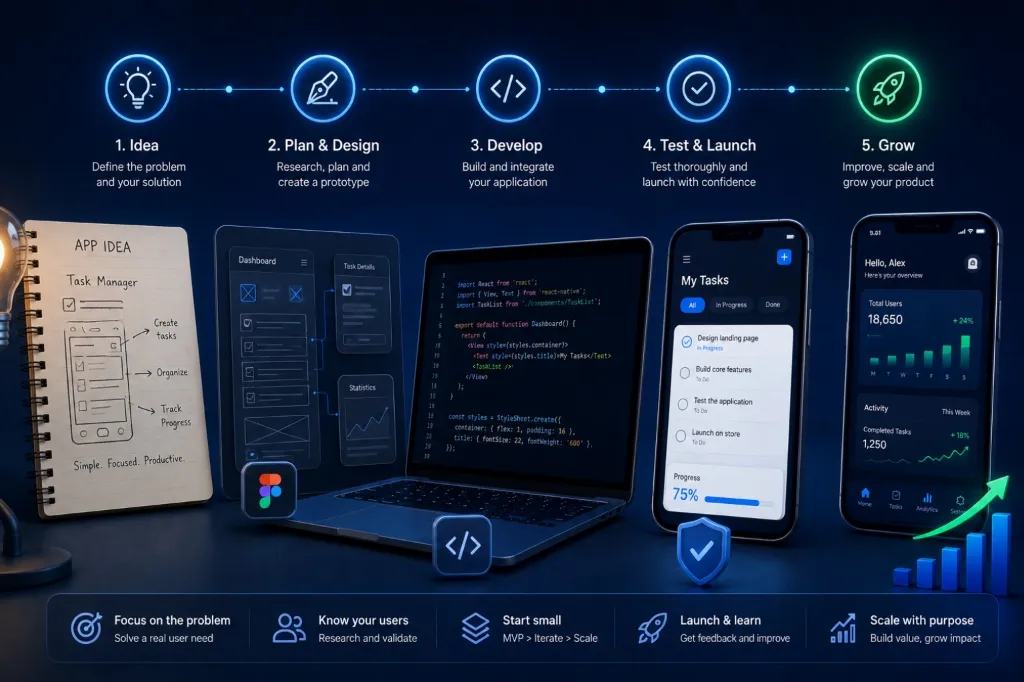
Almost every successful mobile app started as:
- a rough idea
- a business problem
- a simple observation
- or a sentence someone casually said at 2 AM while staring at a whiteboard and caffeine with dangerous optimism.
The challenge is not having an app idea.
The challenge is turning that idea into:
- a functional product
- scalable technology
- real users
- sustainable growth
- actual business value
Most businesses and founders ask:
- Where do I start?
- Do I need developers?
- How much does app development cost?
- What technologies should I use?
- How do startups launch apps?
- How long does app development take?
In this guide, we’ll explain:
- the complete app development process
- how businesses validate app ideas
- what technologies are used
- how MVP development works
- how apps are launched and scaled
- common mistakes businesses should avoid
What Is the First Step in Building an App?
The first step is not coding.
It is defining:
- the business problem
- target audience
- app purpose
- core functionality
- user experience goals
Most failed apps struggle because businesses start development before clearly defining:
- who the app is for
- what problem it solves
- why users would keep using it
Strong app strategy always begins with:
- market validation
- feature prioritization
- customer research
- competitive analysis
How Do Businesses Validate App Ideas?
Before development starts, businesses should validate:
- market demand
- user interest
- competitive opportunities
- monetization potential
Validation commonly includes:
- competitor research
- customer interviews
- MVP planning
- prototype testing
- landing page validation
The goal is reducing risk before investing heavily into development.
Because discovering nobody wants your app after spending six months building it is one of humanity’s more expensive emotional experiences.
What Are the Steps to Create a Mobile App?
Modern mobile app development usually follows several major stages.
1. Strategy & Planning
This phase defines:
- business goals
- target audience
- feature roadmap
- technical requirements
- scalability needs
Strong planning dramatically reduces future development problems.
2. UI/UX Design
The app experience is designed before coding begins.
This includes:
- wireframes
- user flows
- interaction design
- navigation systems
- mobile responsiveness
- visual branding
Tools like Figma are commonly used for:
- app prototypes
- UI systems
- design collaboration
Good UX directly impacts:
- engagement
- retention
- conversion rates
3. MVP Development
Most startups begin with an MVP: Minimum Viable Product.
An MVP includes:
- core features only
- simplified workflows
- launch-ready functionality
- essential user experience systems
The goal is: launch quickly, test market demand, collect feedback, then scale strategically.
Businesses that try building every feature immediately usually create:
- delays
- budget overruns
- technical complexity
- operational chaos
Humans consistently believe they need “just one more feature” before launch. History suggests otherwise.
4. Frontend & Backend Development
This is where actual app development begins.
Frontend Development
Frontend systems handle:
- app screens
- user interaction
- navigation
- mobile responsiveness
Common technologies include:
- React Native
- Flutter
- Swift
- Kotlin
Backend Development
Backend systems manage:
- databases
- authentication
- APIs
- cloud infrastructure
- notifications
- analytics
- payments
Common backend technologies include:
- Firebase
- AWS
- Node.js
- cloud APIs
Strong backend architecture is critical for scalability.
Why React Native and Flutter Are Popular
React Native and Flutter are heavily used because they support:
- cross-platform development
- faster deployment
- reduced development costs
- scalable mobile systems
Businesses can launch:
- iOS apps
- Android apps
from a single codebase.
This is especially valuable for startups and growing businesses.
When Should Businesses Use Native Development?
Native development using:
- Swift for iOS
- Kotlin for Android
is often used when apps require:
- advanced performance
- hardware optimization
- complex mobile functionality
- large-scale enterprise systems
Native apps provide maximum device optimization but usually require larger development budgets.
How Are AI Features Added Into Apps?
Modern businesses increasingly integrate:
- AI assistants
- automation systems
- recommendation engines
- AI chat functionality
- OpenAI-powered workflows
AI app development commonly involves:
- OpenAI APIs
- automation systems
- machine learning infrastructure
- conversational UI
AI functionality adds scalability opportunities but also increases infrastructure complexity.
How Do Apps Handle Payments?
Many apps require payment systems for:
- subscriptions
- e-commerce
- digital services
- memberships
Platforms like Stripe are commonly integrated for:
- secure payments
- subscription billing
- transaction processing
Payment infrastructure requires careful security and compliance planning.
How Are Apps Tested Before Launch?
Professional app development always includes:
- QA testing
- bug fixing
- performance optimization
- device compatibility testing
- security validation
Apps must function properly across:
- devices
- operating systems
- screen sizes
- network conditions
Strong QA processes reduce launch issues significantly.
What Happens During App Launch?
Once development is complete, apps are deployed to:
- Apple App Store
- Google Play Store
Launch preparation usually includes:
- store optimization
- metadata setup
- screenshots
- analytics integration
- crash monitoring
- marketing preparation
App launch is not the finish line.
It is the beginning of:
- optimization
- scaling
- retention
- customer acquisition
How Long Does It Take to Build an App?
Development timelines depend heavily on:
- feature complexity
- integrations
- scalability requirements
- design quality
- AI functionality
- backend systems
Simple MVPs can launch relatively quickly. Enterprise-level platforms require significantly more planning and infrastructure.
Businesses should prioritize:
- strategic execution
- product quality
- scalability
over unrealistic timelines.
How Much Does It Cost to Turn an App Idea Into Reality?
App development costs vary based on:
- app complexity
- design requirements
- AI integrations
- infrastructure
- payment systems
- platform selection
- scalability planning
Businesses commonly reduce costs through:
- phased development
- MVP strategy
- cross-platform frameworks
- feature prioritization
The smartest businesses focus on building:
- scalable foundations
- core user experience
- operational efficiency
first.
What Mistakes Should Businesses Avoid?
Common app development mistakes include:
- building too many features initially
- ignoring scalability
- poor UX design
- weak market validation
- rushing development
- hiring inexperienced developers
- skipping testing
Successful apps are built through:
- iteration
- optimization
- strategic planning
- customer feedback
not rushed feature overload.
Why Long-Term Strategy Matters
The best apps evolve continuously.
Businesses need:
- maintenance
- optimization
- infrastructure scaling
- customer analytics
- feature expansion
- performance monitoring
Apps are long-term digital ecosystems, not one-time projects.
Final Thoughts
Turning an app idea into reality requires:
- strategic planning
- scalable technology
- strong UI/UX
- backend infrastructure
- testing
- optimization
- long-term growth systems
Technologies like:
- React Native
- Flutter
- Swift
- Kotlin
- Firebase
- AWS
- OpenAI
- GitHub
- Figma
- Stripe
have made modern app development more scalable and accessible than ever before.
Businesses that approach development strategically usually:
- reduce costs
- launch faster
- improve scalability
- create stronger customer experiences
- build more successful digital products
At AZ Konnect, we help businesses transform ideas into scalable mobile apps, AI systems, and high-performing digital platforms built for long-term growth.